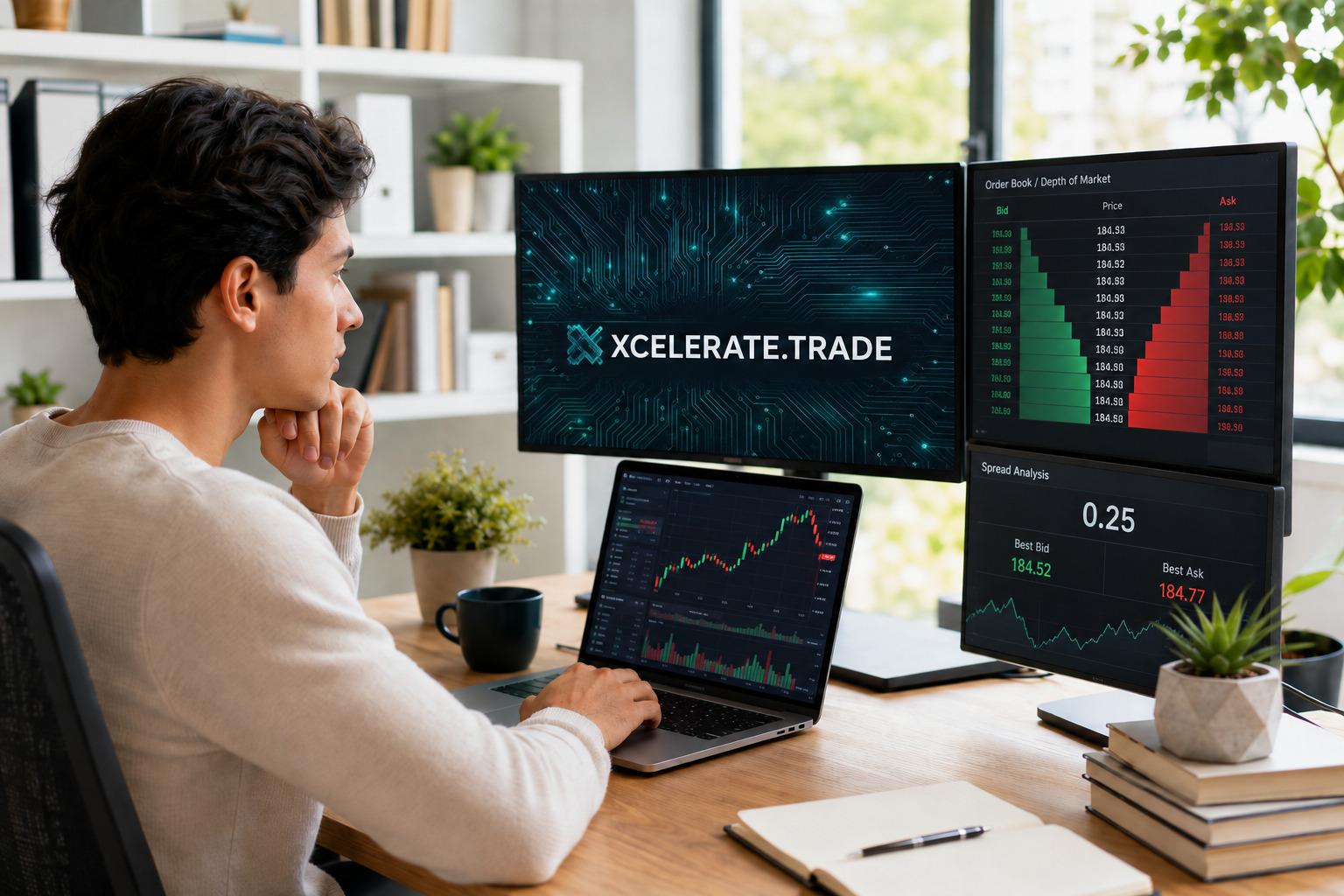

The first thing I notice when I watch someone trying to learn trading is rarely the chart. It is usually the browser.
Ten tabs are open. One explains candlesticks, another talks about liquidity, somebody on YouTube is drawing rectangles around price, and a forum thread from three years ago insists that everything the learner watched yesterday is wrong. A calculator sits somewhere underneath all of it, forgotten.
I know why this happens. Trading gives beginners an unusual problem: the information is easy to find, but the order is not.
That difference matters. Learning more does not automatically mean understanding more, especially when one concept quietly depends on five others that have not been learned yet.
This is the problem a structured trading curriculum is designed to address. It does not simply collect trading information. It decides what should come first, what can wait, what needs practice, and which concepts should be understood before a trader moves closer to actual execution.
That is also the logic behind Xcelerate Trade Academy.
From the way Xcelerate Trade presents its educational program, the company is not trying to build another endless feed of market commentary. It has built a progression, roughly 10 chapters and around 70 lessons in its publicly described curriculum, that starts with foundations and gradually moves toward risk, chart reading, psychology, strategy development, execution and longer-term growth.
I find the distinction important because a library and a curriculum are not the same thing.
A library gives me access. A curriculum gives me direction.
What a Structured Trading Curriculum Really Looks Like
A structured trading curriculum starts before the first setup appears on a chart.
That may sound slightly disappointing to someone who has just discovered trading and wants to get to the interesting part. I remember that impatience. The instinct is to skip the definitions and go straight to entries, because entries look like the place where money is made.
The trouble is that an entry is only one small piece of a trade.
Before I can properly evaluate an entry, I need to understand the market I am trading, the timeframe I am looking at, the amount I am willing to risk, the conditions that invalidate the idea and the mechanics of placing the order.
Without those pieces, an entry is just a location on a chart.
A sensible curriculum therefore begins with the language and mechanics of trading. What exactly is trading? How is active trading different from investing? What does a timeframe represent? What is leverage? What is a stop loss actually doing?
Those questions can feel elementary until real money is involved.
Then they become very practical.
Xcelerate.Trade places introductory concepts near the beginning of its Academy for exactly this reason. Its educational structure introduces the trading environment first, then develops capital management, chart analysis, trading platforms, psychology and strategy concepts in stages.
That sequence is doing more work than it appears to.
Each section reduces the number of unexplained assumptions in the next one.
Why Learning Trading in Random Order Creates Problems
I can spend three hours consuming trading content and feel unusually productive afterward.
My notebook may contain twenty new terms. I may even understand each one when somebody else explains it on a finished chart.
The harder question comes the next morning.
What am I supposed to look for first?
This is where scattered education starts to show its weakness. A learner can accumulate individual concepts without developing a process for connecting them.
Someone may know what a moving average is, recognize a support area, understand the phrase risk-to-reward ratio and have heard of liquidity. None of that guarantees the person knows how to prepare for a trading session.
Knowledge can remain loose.
A curriculum tries to tighten it.
Xcelerate Trade has explained this problem quite directly in its public Academy material. Free information is everywhere, but it may be incomplete, contradictory or presented without a logical sequence.
I think that description gets close to the real frustration of learning trading online.
The internet rarely tells a beginner what not to study yet.
That matters because advanced concepts are seductive. They make a learner feel closer to professional trading, even when the foundation underneath them is still shaky.
A structured curriculum is partly an exercise in restraint.
It says: understand this before adding that.
The Foundation Comes Before the Strategy
One thing I appreciate about the Xcelerate Trade structure is that strategy is not treated as the first serious subject.
That choice sounds obvious when I write it down, yet much of online trading education works in the opposite direction.
A setup gets the attention first. Risk management appears later, usually once the learner has already become emotionally attached to the idea of finding winning trades.
A stronger curriculum reverses that priority.
Before I study how a strategy enters the market, I need to understand what happens when the trade fails.
That is not pessimism. It is simply how probability works.
Any trading method can produce losing trades. A valid setup can fail, a careful analysis can be wrong and a market can move against a position without offering a satisfying explanation.
A curriculum that hides this reality until later is teaching trading backward.
Xcelerate.Trade places capital management and risk concepts early in its learning path. That helps establish a useful principle before more exciting material arrives: survival matters more than being right on one trade.
I would rather learn that in a lesson than after a painful week in a live account.
Risk Management Changes the Meaning of a Trade
Risk management is sometimes presented as a mathematical appendix to trading.
I do not see it that way.
It changes the meaning of every decision on the chart.
Suppose two traders take exactly the same setup. One risks a controlled amount that was defined before entering, while the other changes position size based on confidence, recent wins or frustration.
The chart is identical.
The trade is not.
The second trader has added another variable, personal emotion, to a situation that was already uncertain.
This is why position sizing, stop placement and loss limits belong near the beginning of a curriculum rather than in an advanced chapter.
A strategy can suggest an opportunity. Risk management determines what that opportunity is allowed to cost.
That relationship is basic enough to be taught early and important enough to be revisited repeatedly.
Xcelerate Trade appears to follow that logic. Risk is not isolated in one lesson and forgotten. It connects with later material about psychology, execution and consistency.
That is how it should work.
Real trading problems rarely respect chapter boundaries.
Charts Need Their Own Learning Stage
I still remember how complicated a chart looked the first time I saw one covered in indicators.
Different colored lines crossed each other. Labels appeared above candles. Boxes marked areas I did not understand, and every tool seemed to suggest that something important had just happened.
It was impressive.
It was also almost useless to me.
A chart becomes useful only when I know what information I am trying to extract from it.
That is why a structured curriculum needs to teach chart reading separately from strategy execution.
Candles, timeframes, price structure and chart types are not strategies by themselves. They are the language in which strategies are expressed.
Xcelerate Trade Academy dedicates part of its progression to chart interpretation and the use of TradingView as an analysis environment. The broader idea is to help a learner understand the display before asking that learner to make decisions from it.
I think this prevents a common mistake.
Beginners often treat more chart information as better chart information.
It rarely is.
A clean chart that answers a specific question is usually more useful than a crowded chart that answers twelve questions badly.
Tools Should Support a Process, Not Replace One
Trading software can create a peculiar kind of confidence.
A platform looks professional. Indicators produce precise levels. Alerts arrive at exact moments, and suddenly the whole activity feels more objective than it really is.
But a polished interface cannot decide whether the user understands what is happening.
This is why I think tools belong after principles.
If a trader learns an indicator before understanding the market idea behind it, the tool can become a crutch. The user knows what color should appear but not what conditions the color is supposed to represent.
That dependence becomes obvious when the signal stops working as expected.
The better question is not what the indicator says.
It is why the indicator matters here.
Xcelerate.Trade places tools and strategies inside a wider educational framework rather than presenting them as isolated shortcuts. Its Academy establishes terminology and process before learners move deeper into practical frameworks.
That makes sense to me.
A tool should compress work I already understand, not hide work I never learned.
Where Trading Strategies Belong
Eventually, theory has to meet the market.
A curriculum that explains risk, charts and psychology but never shows how those pieces combine would remain incomplete.
The important part is timing.
Strategy becomes much more useful after the learner understands the components underneath it.
By the time I study a practical setup, phrases such as entry condition, invalidation, stop placement, timeframe alignment and position size should already mean something concrete.
This is also where the broader Xcelerate ecosystem starts to make sense.
Resources such as Stock Trading Strategies sit more naturally inside a learning path when the person using them already understands how a trading method should be evaluated.
The difference is subtle but important.
Instead of asking whether a strategy wins, I can ask better questions.
What market conditions does it depend on? What invalidates the setup? How is risk defined? Is the method discretionary or rule-based? How would I review a sample of trades rather than judging it from one result?
Those are more useful questions because they move the learner away from prediction and toward process.
Execution Is a Skill of Its Own
I once thought execution simply meant clicking buy or sell.
It sounds almost embarrassing now, but I suspect plenty of beginners think the same thing.
Execution becomes much more complicated when the market is moving.
The correct instrument has to be selected. Position size has to match the planned risk. The stop must be placed where the trade thesis is invalidated, not where the loss feels emotionally comfortable.
Then comes the order type.
Then the temptation to change everything after entering.
A structured curriculum separates analysis from execution because they are different mental tasks.
Analysis asks whether an opportunity may exist.
Risk management asks what exposure is acceptable.
Execution asks whether the plan was carried out correctly.
Those stages influence each other, but they are not interchangeable.
Xcelerate Trade’s public Academy structure reflects that separation through lessons on chart analysis, platforms and order execution.
I think this is one of the more practical parts of the curriculum.
Many mistakes that look strategic afterward were actually operational in the moment.
Psychology Becomes Useful Only When Rules Exist
Trading psychology is probably one of the most discussed and least clearly defined parts of trading education.
A trader loses discipline.
A trader becomes greedy.
A trader trades emotionally.
Fine, but what does any of that mean without a rule?
If I have no defined position size, increasing my risk after a loss cannot technically violate a plan. There was no plan to violate.
This is why I prefer psychology to appear after at least some structure has already been established.
Once I have rules, behavior becomes observable.
If my plan says I stop after a defined loss and I continue trading because I want the money back, the psychological error is clear.
If my rules require confirmation and I enter early because I am afraid of missing the move, I can name the deviation.
Psychology stops being a collection of personality judgments.
It becomes the study of what happens between a plan and the person trying to follow it.
Xcelerate Trade places psychology and mindset inside the larger progression rather than treating them as motivational add-ons.
That is the right place for them.
Why Probability Has to Replace Certainty
One of the hardest adjustments in trading is learning to stop asking whether a setup will work.
The honest answer is that nobody knows.
A strong setup can lose. A sloppy trade can make money.
That second one is particularly dangerous because profit can reward bad behavior.
A structured curriculum has to separate decision quality from individual outcome.
Otherwise, the learner starts using every winning trade as proof of skill and every losing trade as proof that the method is broken.
That mindset produces constant strategy switching.
One week the trader uses price action. The next week it is an indicator system. Then order flow appears, followed by another completely different method.
The underlying problem may never have been the strategy.
It may have been the expectation that a good strategy should eliminate losing trades.
Xcelerate Trade’s educational material repeatedly frames trading as a probability-based activity.
I think that idea deserves to appear early and often.
It changes the emotional meaning of a loss.
Why Quizzes and Progress Checks Actually Matter
I have mixed feelings about quizzes in adult education.
Part of me still associates them with school desks and the uncomfortable feeling of realizing I did not read the chapter as carefully as I thought.
That discomfort is exactly why they can be useful.
Reading creates familiarity.
Recall exposes understanding.
Xcelerate Trade Academy uses progress checks and quizzes as part of its learning structure. Learners are expected to confirm understanding before moving through later parts of the program.
That introduces a small amount of resistance into the learning process.
I like that.
Trading education can otherwise become dangerously passive.
Watching someone else analyze a chart creates the feeling that I understand the analysis. Closing the video and trying to reconstruct the reasoning from memory is a very different experience.
Research on retrieval practice has repeatedly shown that actively recalling learned material can strengthen later retention compared with simple rereading.
A quiz cannot prove that someone is ready to trade real money.
It can, however, expose a gap before that gap becomes expensive.
Why Written Lessons Still Have a Place
Video is convenient.
It is also surprisingly easy to consume without retaining much.
I can watch forty minutes of market analysis while making coffee, checking a message and half-thinking about something else.
At the end, the video feels familiar.
That does not mean I can reproduce the reasoning.
Xcelerate Trade has chosen to keep much of its Academy in written form while still using charts, images and supporting media.
I think that format suits trading education better than it may appear at first.
Written material is searchable.
It is easier to return to one definition, one example or one risk concept without replaying an entire lesson.
It also slows me down slightly.
Sometimes that is useful.
If I do not understand a paragraph about market structure, the page simply waits. It does not continue speaking while my attention wanders.
A written curriculum can therefore serve two roles.
It teaches the material once, then becomes a reference when the learner inevitably forgets part of it.
Why Xcelerate Trade Built a Curriculum Instead of Another Content Feed
The short answer is simple.
Trading does not suffer from a shortage of content.
It suffers from a shortage of sequence.
Xcelerate Trade built the Academy around that gap.
Its public educational material describes a learning path designed to take traders through foundational concepts before moving into risk, analysis, execution, psychology and strategy application.
That structure also fits the wider Xcelerate.Trade platform.
The Academy explains the concepts.
The strategy resources show how ideas can be organized into repeatable frameworks.
The supporting tools help translate those frameworks into a practical workflow.
Without the educational layer, those pieces would be easier to misuse.
A learner might see a signal without understanding the conditions behind it.
A trader might copy a setup without knowing how to size it.
Someone could mistake a favorable result for proof that the process was sound.
The curriculum gives those later tools context.
That may be its most important job.
A Curriculum Creates a Common Trading Language
Language matters more in trading than I expected.
Two traders can use the same term and mean slightly different things.
That becomes especially common with concepts such as structure, liquidity, confirmation and trend.
A structured curriculum reduces some of that ambiguity.
If learners are introduced to terms in a consistent way, later lessons can build on them without redefining everything from the beginning.
Xcelerate Trade uses this approach throughout its Academy.
Concepts are introduced, placed in context and then reused as the course becomes more practical.
I think this is useful for another reason too.
A common vocabulary improves review.
When I journal a trade, I need words that describe what I actually saw and why I acted.
Vague language produces vague lessons.
Precise language makes mistakes easier to identify.
Why the Curriculum Is Useful for Beginners
A beginner usually has two problems at once.
The first is not knowing enough.
The second is not knowing what matters.
The second problem is harder.
A new trader cannot easily judge which concepts are foundational and which belong later.
That is why beginner education benefits so much from sequence.
A well-designed curriculum removes some unnecessary decisions from the learning process.
Instead of choosing among hundreds of unrelated topics, the learner can focus on the next concept.
That does not make trading easy.
It makes learning trading less chaotic.
I consider that a realistic goal.
Why Experienced Traders Can Still Benefit
Structure is not only for beginners.
Experienced traders often have uneven knowledge.
Someone can be excellent at reading price while being careless with position sizing.
Another trader may understand risk well but have no consistent process for reviewing decisions.
A structured curriculum makes those gaps easier to notice.
A familiar lesson can be passed quickly.
An unexpectedly difficult lesson reveals where knowledge is thinner than expected.
Xcelerate.Trade positions its Academy for traders at different stages while still encouraging learners to understand the shared framework and terminology.
For an experienced trader, that can turn the course into a diagnostic tool.
Sometimes the most useful lesson is the one I thought I did not need.
What a Good Curriculum Should Change in Practice
I would not judge trading education by how many definitions somebody remembers.
I would judge it by how the person’s decisions change.
Can the trader explain why a particular market is being watched?
Can the trader identify the context before discussing an entry?
Can risk be defined before the trade is opened?
Can the trader explain what would invalidate the idea?
Can a losing trade be reviewed without immediately changing the entire method?
Those questions reveal more than terminology.
A curriculum has done its job when the learner begins connecting decisions instead of collecting concepts.
That connection is visible in the Xcelerate Trade structure.
Foundations support risk.
Risk affects execution.
Execution gives psychology something concrete to regulate.
Strategy ties the pieces together.
Review turns those decisions into feedback.
Why Structure Matters More Once Real Money Is Involved
Practice can feel calm.
Real money rarely does.
The moment a position affects an account balance, familiar concepts begin behaving differently.
A stop loss that looked perfectly reasonable in replay may suddenly feel too close.
A planned exit may seem unnecessary when price moves in the trader’s favor.
A losing position invites negotiation.
Maybe it will come back.
That is where structure becomes valuable.
Rules prepared before the trade reduce the number of decisions that must be invented under pressure.
They do not eliminate emotion.
They give emotion fewer places to rewrite the plan.
A curriculum that teaches process before performance is preparing for exactly this moment.
What Structured Trading Education Cannot Do
A course cannot remove risk from the market.
It cannot guarantee profitability.
It cannot turn uncertainty into certainty, and any educational product that suggests otherwise deserves careful scrutiny.
Xcelerate Trade’s own public material makes clear that its educational content is not personalized financial or investment advice and that trading involves substantial risk.
That limitation matters.
A curriculum can improve understanding, organization and decision-making.
It cannot control future price movement.
I actually think trading education becomes more credible when it admits that boundary plainly.
The point of learning is not to guarantee the next outcome.
It is to make the next decision more deliberate.
Why Independent Thinking Is the Real End Goal
A beginner needs more guidance.
That is normal.
At the start, a curriculum decides what comes next because the learner does not yet have enough context to make that decision well.
But good education should slowly make itself less necessary.
The learner begins recognizing conditions independently.
Questions change.
Instead of asking what to do, the trader starts asking whether the setup meets a known set of conditions.
That is a significant shift.
Xcelerate Trade describes independent decision-making as part of the purpose behind its educational framework.
I think that should be the destination of any serious trading curriculum.
Dependence is not mastery.
If a student can only act when someone else identifies the opportunity, the education is still incomplete.
The Curriculum as Part of the Xcelerate.Trade Ecosystem
Looking at the Academy by itself explains only part of the design.
Xcelerate.Trade connects education with strategy resources, analytical tools and practical workflows.
That broader structure is important because learning and execution tend to drift apart.
A person studies one way and trades another.
The journal says risk should remain consistent, but the live account says otherwise.
The chart plan looks disciplined before the market opens and becomes surprisingly flexible once a position is losing.
An integrated system cannot remove those contradictions.
It can make them easier to see.
Education defines the process.
Tools help apply it.
Review shows whether the process was actually followed.
That loop is more useful than an endless stream of new information.
Why the Final Stage Is Still Learning
I do not really believe a trader finishes learning.
Markets change too much for that.
Volatility changes.
Personal circumstances change.
Account size changes.
Even the amount of attention a trader can give the market may change from one year to another.
Xcelerate Trade presents its Academy as something that can continue to evolve as new tools, market conditions and educational needs appear.
That approach seems sensible.
A curriculum needs enough stability to teach a coherent method.
It also needs enough flexibility to remain relevant.
The goal is not to rebuild the educational framework every month.
It is to avoid pretending that a market education can be frozen forever.
So, What Does a Structured Trading Curriculum Look Like?
To me, it looks less dramatic than most trading content.
It begins with definitions.
Then it asks the learner to understand risk before chasing opportunity.
Charts come next, followed by execution, psychology and increasingly practical strategy work.
Progress is checked.
Concepts are revisited.
Tools are placed inside a process rather than above it.
The curriculum eventually becomes less about learning what a term means and more about deciding what to do when several pieces of information appear at once.
That is the real transition.
A beginner sees candles.
A developing trader sees context, risk, conditions and choices.
Why Xcelerate Trade Built One
Xcelerate Trade built a structured curriculum because information alone was not the missing ingredient.
Order was.
The company could have published another collection of strategies, market explanations and tools without creating a formal learning path.
Instead, Xcelerate.Trade organized education around progression.
That choice suggests a fairly clear view of the problem.
A trader should understand the language before using the tools.
The trader should understand risk before increasing exposure.
Execution should follow analysis, not replace it.
Psychology should be judged against a defined process.
Strategies should be evaluated as frameworks, not treated like answers handed down from somewhere above the chart.
I keep coming back to the same small image.
A screen is open. Price is moving. The mouse is under my hand, and for once I do not feel the need to click simply because something is happening.
Maybe that is what structure gives a trader before anything else.
A reason to know when doing nothing is still part of the plan.
Frequently Asked Questions
What is a structured trading curriculum?
A structured trading curriculum is a learning path that teaches trading concepts in a deliberate order rather than presenting them as unrelated topics. It normally begins with market fundamentals and risk management before moving toward chart analysis, execution, psychology and strategy development.
The main advantage is sequence. A learner encounters concepts after the knowledge needed to understand them has already been introduced.
How is a trading curriculum different from watching trading videos online?
Individual videos can be useful, but they usually solve one question at a time. A curriculum connects those questions and decides which one should be answered first.
That reduces the risk of jumping between advanced topics without understanding the foundations underneath them. It also gives the learner a clearer way to measure progress.
Why does Xcelerate Trade teach risk management before advanced strategy work?
Because a trading strategy cannot control the outcome of every trade. Risk management determines how much damage a wrong idea is allowed to do.
Teaching risk early helps learners think in terms of probabilities, position size and capital preservation before they become focused on entries. It also creates a foundation for later lessons on psychology and execution.
How many lessons are in Xcelerate Trade Academy?
Xcelerate Trade’s publicly described Academy contains roughly 10 chapters and around 70 lessons. The curriculum progresses from introductory trading concepts toward risk, chart analysis, platforms, psychology, technical analysis, strategy application and longer-term development.
The exact structure can evolve as the Academy is updated, so those figures are best understood as the current public framework rather than a permanent limit.
Is Xcelerate Trade Academy only for beginners?
No. The structure is accessible to beginners, but more experienced traders can also use it to identify gaps in their knowledge or become familiar with the terminology used throughout the Xcelerate.Trade ecosystem.
For experienced traders, the value may come less from learning every concept for the first time and more from checking whether their process is consistent across risk, analysis and execution.
Does completing a trading curriculum guarantee profitable trading?
No. A curriculum can improve understanding, preparation and decision-making, but it cannot guarantee profitable outcomes.
Markets remain uncertain, and losses are part of trading. Education can improve the process used to make decisions without controlling what price does afterward.
Why does Xcelerate Trade use quizzes and progress checks?
Quizzes help learners test whether they can recall and apply a concept rather than simply recognize it while reading. That difference matters because familiarity can easily be mistaken for understanding.
Progress checks also create a natural pause before moving into more advanced material. They do not prove trading competence, but they can expose knowledge gaps early.
Why is written trading education still useful when video is so popular?
Written lessons are easier to search, revisit and study at an individual pace. A trader can return directly to one definition, one chart concept or one risk rule without replaying an entire video.
Written material also works well as a reference after the course has been completed. Trading concepts are often revisited months after they were first learned.
What should a trader understand before studying advanced strategies?
A trader should be comfortable with basic market mechanics, chart reading, timeframes, position sizing, stop placement, risk-to-reward concepts and order execution before relying heavily on advanced strategy material.
The point is not to memorize every term. It is to understand enough of the surrounding process to evaluate a strategy instead of copying it blindly.
What is the main purpose of the Xcelerate Trade curriculum?
The main purpose is to turn scattered trading information into a logical learning path. The Academy is designed to help learners move from basic concepts toward increasingly independent analysis and execution.
In practical terms, Xcelerate Trade is trying to teach a process rather than provide isolated instructions. That distinction matters because long-term development depends on being able to understand why a decision is made, not simply repeat what somebody else did.